Statement: Rabaa… a Remembrance That Will Not Die, and Justice That Has Not Been Achieved
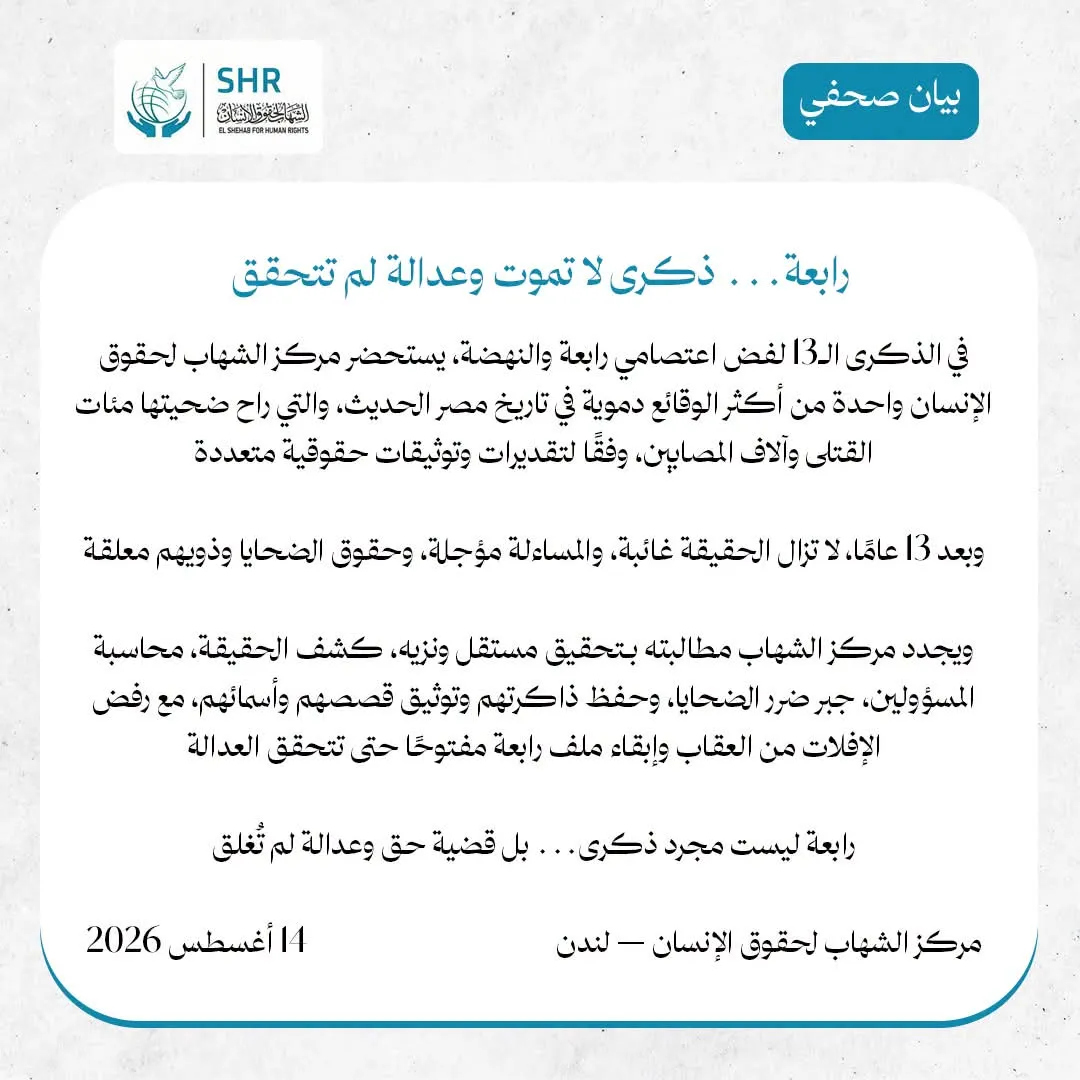
Statement
Rabaa… a Remembrance That Will Not Die, and Justice That Has Not Been Achieved
The events of the dispersal of Rabaa al-Adawiya and al-Nahda on 14 August 2013 represent a decisive turning point in modern Egyptian history. They were not merely passing political confrontations, nor a routine security measure to restore “public order.” Rather, it was the moment when the “template of the current system” was drawn up, and its structural features were defined as a model of authoritarian rule—one that placed itself anew above the state, extending its control over all its levers and institutions, while operating outside both the legal and judicial systems. It also surpassed, in its brutality and predatory reach, all prior experiences of rule in the country. Moreover, it re-engineered the relationship between authority and civil society on the basis of systematic repression, after undermining all the fragile democratic gains achieved by society through decades of struggle.
On the thirteenth anniversary of these events, there is no dispute about the success of the 2013 system in eliminating the entire political opposition, silencing voices, confiscating freedoms, and closing the public sphere completely—establishing a horrifying state of acute societal polarization.
That morning, thirteen years ago, the worst massacre in Egypt’s contemporary history took place. It was broadcast live on air, before the eyes of the entire world. Rabaa al-Adawiya Square was transformed—from a sit-in for peaceful protest—into: “the largest mass killing operation in modern history,” after the coup plotters rejected political solutions and chose to resort to brutal force.
The National Council for Human Rights documented the deaths of 632 people, while ignoring the bodies of unknown identity. Meanwhile, human rights organizations documented the killing of at least 817 people at Rabaa alone, with estimates suggesting the number may have exceeded one thousand. Field hospital estimates and testimonies of survivors indicate that more than 2,600 people were killed.
The fires set by the security attackers did not only consume human lives; they also engulfed the field hospital and the corpses of the dead. Survivors described the scene as a “pyre” for both the living and the dead.
Human Rights Watch described the events as a “crime against humanity,” fully constituted under international law, based on the following criteria: premeditated intent and prior planning for mass killing; and the lack of proportionality in the use of force. According to the Ministry of Interior’s account, only (15 firearms) were seized in a square containing tens of thousands of peaceful sit-in protesters, in contrast to a wide-scale assault in which armored vehicles, aircraft, and heavy weapons were used. This undermines the narrative of “self-defense” and confirms the retaliatory nature of the attack.
As for Amnesty International, it considered the massacre a “decisive turning point” for human rights in Egypt.
At the regional level, the “Rabaa model” became a template for modern tyranny. International silence provided a green light and inspiration for regional regimes and occupying forces to use “the maximum level of violence” against peoples under the pretext of combating terrorism.
After more than a decade and a half since the tragedy, the “Rabaa template” was transformed into a sustainable governance strategy to silence the opposition through a legislative arsenal that ensured the fortification of the regime and legalized impunity. This was done through the public law of 2018, which granted military leaders immunity from prosecution for events that occurred between July 2013 and June 2014. In return, tens of thousands of opposition figures were imprisoned, while torture spread and “enforced disappearance” practices were used as tools of intimidation.
Meanwhile, the Egyptian situation remained closer to a “zero-sum battle” between an oppressive, dictatorial regime and an opposition that had been completely marginalized, under a deliberately blocked horizon for justice. The aim was to close the door to accountability forever. As must be reiterated, those who survived the horrific massacre at Rabaa were taken to prison under a planned killing scheme. Those who did not die through medical negligence, or through systematic physical torture and inhuman or degrading treatment, could be dealt with through execution. This is what prompted the Al-Shehab Human Rights Center to renew its demands for justice for the victims and their families, and to call on the Egyptian government to acknowledge its responsibility for the massacre and the violations that followed.
Al-Shehab Center Recommendations
1/ Open an independent, comprehensive, and impartial investigation into the dispersal of Rabaa and al-Nahda, identifying responsibility for issuing orders, carrying out actions, and any cover-up.
2/ Ensure the right of victims and their families to truth, justice, and reparation for harm, and not reduce victims to mere numbers or statistics.
3/ Hold accountable everyone whose responsibility is proven for killings or for the unlawful use of force, regardless of their position, rank, or political affiliation.
4/ Establish an independent international mechanism to ascertain the facts and preserve evidence, in light of the national authorities’ stalling in conducting an independent and effective investigation.
5/ Urge the international community to use legally available accountability tools, including targeted sanctions, travel restrictions, and asset freezes.
6/ Reform law enforcement institutions, review rules on the use of force, and ensure that security agencies are subject to effective legal and judicial oversight.
7/ Ensure that state agencies do not use repression against political opposition, and respect the right to life, assembly, expression, and peaceful protest.
8/ Preserve the memory of the victims and document their names and stories, and emphasize that the passage of time or political disagreement does not extinguish their right to justice. Ongoing documentation is the first act of resistance against forgetting.
9/ Reject a policy of impunity as an additional violation of victims’ rights.
10/ Keep the Rabaa file open until justice and accountability are achieved.
11/ Call for a comprehensive societal and political reconciliation, beginning with the release of political detainees, compensating victims and their families, the Egyptian government’s acknowledgment of its responsibility for the massacre and the violations that followed, and the prosecution of those responsible.
12/ Immediately repeal the July 2018 law, as it conflicts with the peremptory rules of international law that prohibit fortification (immunity) in crimes of mass killing.
13/ Activate transitional justice, and commit to Article 214 of the Constitution by issuing a law that guarantees the uncovering of the truth, accountability, and reparation for victims—materially and morally.
14/ Establish an international mechanism to protect testimonies and documents (an independent national archive) to ensure they are not subjected to falsification or lost.
15/ Suspend the death penalty against political opponents, especially in the Rabaa case, and release tens of thousands of detainees.
In conclusion
After thirteen years, the Rabaa massacre remains a bleeding wound in Egypt’s collective memory and an obstacle to any real stability.
Attempts by the authorities to “erase memory” through urban changes to the squares or the legal fortification of the perpetrators will not succeed, because crimes against humanity remain alive—never subject to statutes of limitation—in the conscience of peoples and in the records of international law.
“Rabaa remembrance” will continue to symbolize the rift that has not healed within the fabric of the Egyptian state, and the inspiring driver for demanding justice. Justice delayed is justice denied—so that the victims’ suffering does not turn into nothing more than a memory without any return.
Al-Shehab Center for Human Rights - London 14 August - Commemoration of the Rabaa Massacre