Education Between International Commitments and Reality
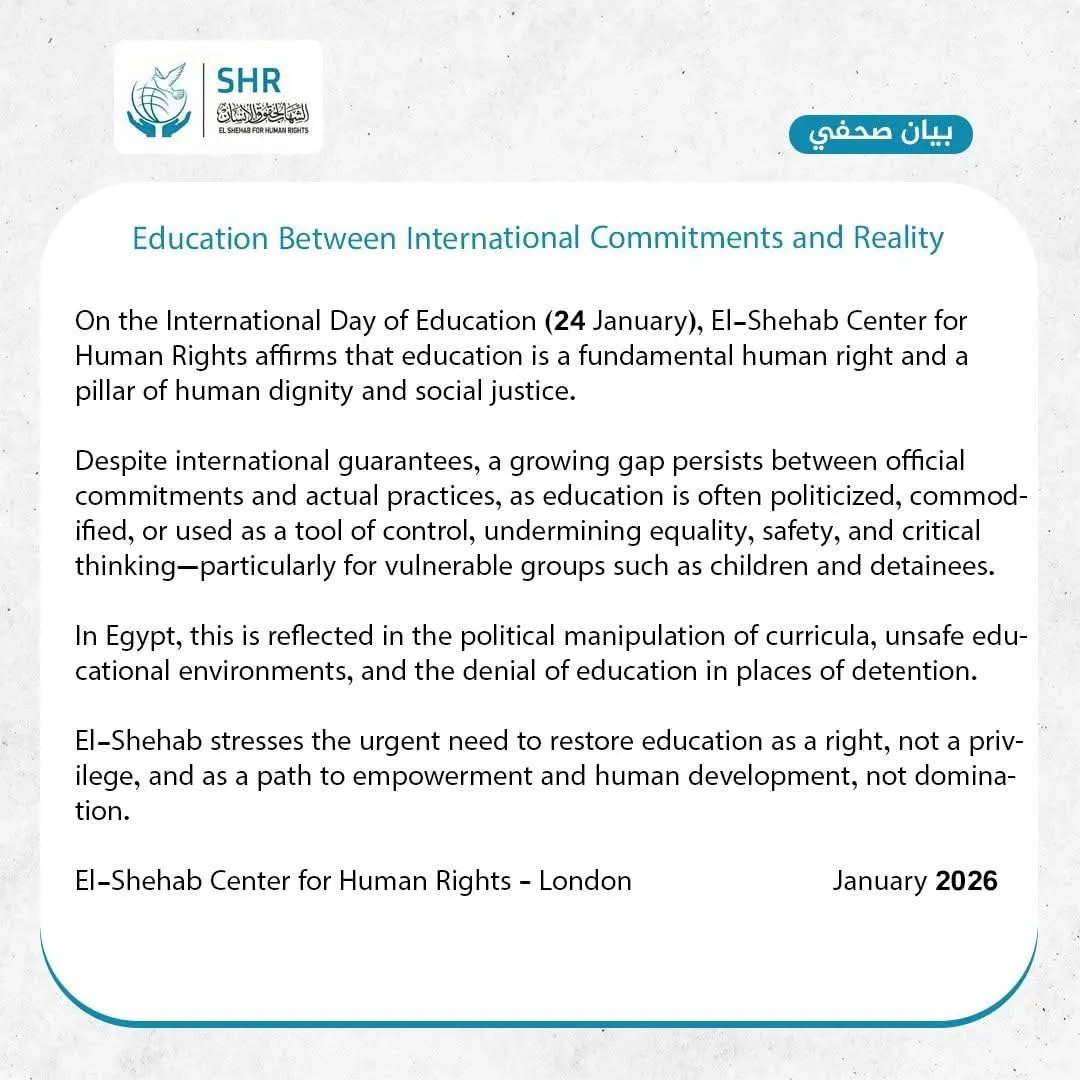
Education… Between International Texts and Actual Practices
On the occasion of the International Day of Education, observed annually on January 24, fundamental questions are once again raised regarding the reality of education and its true role in building human beings and safeguarding human dignity. In light of the affirmations contained in international conventions and United Nations declarations, education is not merely a social service or a vocational pathway, but rather an inherent human right and one of the core pillars for achieving social justice and sustainable development.
While El-Shehab Center for Human Rights values the international gains achieved in the field of the right to education, and the guarantees enshrined in international treaties and UN agreements to protect this right as a cornerstone of human dignity and sustainable development, it simultaneously emphasizes that these commitments remain incomplete as long as they are not effectively reflected at the national level. This is particularly evident given the growing gap between official discourse that stresses the importance of education and actual practices that, in many cases, transform it into a tool of indoctrination, distortion, discrimination, social control, or the privatization of knowledge—thereby undermining the principle of equal opportunities—instead of being a space for freedom, knowledge, and critical thinking.
This global occasion also comes amid accumulated challenges facing educational systems, ranging from crises of quality, declining safety within educational institutions, and the widening gap between public and private education, to the exclusion of education from the most vulnerable groups, including marginalized children and detainees inside places of detention. Such realities constitute a clear violation of the philosophy of education as a right that is indivisible and non-excludable.
From this perspective, this statement seeks to critically and rights-based examine the reality of education by placing it within its local and international contexts, and by linking education as a human right with the structural challenges that prevent its realization in a fair, safe, and inclusive manner.
First Perspective:
Education cannot be viewed as a neutral cognitive process or merely a technical mechanism for transmitting information. Rather, it is a tool for shaping awareness and building human beings. This makes state control over education one of the most dangerous instruments of political and social power. The danger becomes evident when science and education are transformed from methodologies of inquiry and questioning into a sanctified and directed discourse that is imposed rather than debated, producing obedient minds instead of free and critical ones.
Second Perspective:
This direction is not limited to local authorities alone; it sometimes extends to an international dimension, where powerful states and global financial institutions influence the educational policies of debt-burdened countries through economic conditionalities imposed under loan agreements and “reform” programs linked to the International Monetary Fund. These policies often serve interests related to normalization and political alignment. As a result, education is reshaped to serve the needs of the global economic and political market rather than the genuine needs of national societies. Its role is reduced to producing employable labor at the expense of critical thinking, the humanities, and cultural identity, thereby entrenching long-term epistemic dependency.
In the Egyptian Context:
First:
The educational system in Egypt has witnessed political manipulation of school curricula, whereby distorted and guided narratives of the revolution have been presented to serve a single official discourse while excluding pluralism and the right to knowledge. This approach has contributed to the erosion of students’ critical awareness and has transformed education from a space for understanding and analysis into a mechanism for reproducing pre-prepared political narratives, in contradiction with international principles that guarantee the right to objective and unbiased education.
Second:
At the same time, some educational facilities have become unsafe environments for children amid the rise in incidents of harassment and sexual abuse, including practices amounting to the sexual exploitation of children. This occurs in the absence—or clear insufficiency—of institutional oversight and accountability mechanisms. This reality reflects a grave failure to protect students and constitutes a direct violation of their right to a safe educational environment that preserves their dignity and physical and psychological integrity.
Third:
The right to education in prisons and places of detention remains among the most marginalized rights. Thousands of detainees are deprived of continuing their education or enrolling in literacy programs and university education, despite this right being guaranteed under national laws and international conventions. This deprivation is part of a broader punitive approach in which denial of education is used as an additional tool of isolation and deprivation, undermining opportunities for rehabilitation and social reintegration.
Overall Assessment:
This complex landscape reveals that the crisis of education is not merely a crisis of curricula or budgets, but rather a crisis of philosophy and vision. The fundamental question remains: Is education intended to be a path to liberation and the building of conscious individuals, or a tool for reproducing dependency, controlling society, and emptying minds of their capacity for questioning and accountability?
Accordingly, genuine advancement of the education system—whether in schools, universities, or even prisons—requires restoring education as a right rather than a privilege, a responsibility rather than a commodity, and a path to liberation rather than an instrument of domination. A society in which education is restricted, directed, or denied to the most vulnerable is a society that reproduces its crises generation after generation.
Recommendations and Aspirations:
• End the political instrumentalization of educational curricula and ensure that the history of the revolution and contemporary events is presented in an objective and pluralistic manner that respects students’ right to knowledge.
• Guarantee a safe educational environment by activating independent oversight mechanisms within schools, conducting serious and transparent investigations into cases of harassment and sexual abuse, and holding all responsible parties accountable without exception.
• Protect children and students from all forms of violence and exploitation within educational institutions, while providing safe reporting mechanisms and psychological and legal support for victims.
• Guarantee the right to education in prisons and places of detention without discrimination, allow detainees to continue their education, and end the use of educational deprivation as a punitive measure.
• Reduce class-based educational inequality by supporting public education, improving teachers’ conditions, and preventing the transformation of education into a commodity dependent on financial capacity.
• Commit to international conventions related to the right to education and children’s rights, and ensure the independence of educational policies from economic and political dictates.
• We also recommend that the Ministry of Education adopt a comprehensive reform vision to advance the educational system, based on guaranteeing the right to free, fair, and equal-opportunity education that respects individual differences and upholds the dignity of both students and teachers. We stress the importance of developing curricula that promote critical and scientific thinking, moving away from rote memorization, indoctrination, or political instrumentalization of content, while involving educational experts and teachers in review and development processes. We further emphasize the necessity of improving teachers’ financial and professional conditions and providing genuine, sustainable training that reflects positively on educational quality. Additionally, we recommend reconsidering evaluation and examination systems to ensure fairness and transparency and to reduce psychological pressure on students, alongside improving school infrastructure, reducing classroom overcrowding, and ensuring readiness for digital transformation before imposing it. Finally, we underscore the importance of strengthening good governance within the educational system and halting any practices that undermine the independence of education or turn it into a tool of control or exclusion, in order to fulfill the core purpose of education in building human beings, awareness, and society.
El-Shehab Center for Human Rights – London
January 2026